
Political Theatre in Zimbabwe
A Conversation between Daniel Maposa and Dan Friedman
The Drama Review (TDR) 69:4 (T268) Winter 2025, pp. 172-184
Dan Friedman
[+DOWNLOAD] Dan Friedman (Let’s Learn!) is a playwright, director, theatre historian, and life-long grassroots educator and activist. He is a founder of the Castillo theatre and a co-convener of Performing the World. His book, Performance Activism: Precursors and Contemporary Pioneers, the first book-length study of performance activism, was published by Palgrave in 2021. He currently is on the faculty of the East Side Institute, managing producer of the Institute’s podcast, All Power to the Developing, and project manager of Let’s Learn!, a global community-engaged educational project of Lloyd International Honors College of the University of North Carolina at Greensboro in collaboration with the East Side Institute. danfriedmannyc@gmail.com
Daniel Maposa (University of the Witwatersrand) is a PhD candidate in Cultural Policy and Management at the School of Arts. He has been active as an actor, director, playwright, and producer in progressive, socially engaged theatre since the mid-1990s. In 2006 he founded and is Executive Director of Savanna Trust, a Zimbabwean-based arts organization that uses theatre, lm, and radio to engender social change and development. Under the Mugabe regime, at great political and personal risk, he organized the Protest Arts Festival, which brought together progressive political performers and artists from throughout Southern Africa and beyond. wamambod@gmail.com
This conversation between Daniel Maposa, the founder and executive director of Savanna Trust, a theatre based in Harare, Zimbabwe; and Dan Friedman, a cofounder and artistic director emeritus of the Castillo Theatre in New York City, took place on 15 November 2022 on Zoom as an offering of Let’s Learn! The free learning/teaching community of online classes, workshops, conversations, and performances with people from all over the globe is a joint project of the East Side Institute, based in New York, where Friedman is on the faculty, and Lloyd International Honors College of the University of North Carolina, Greensboro, where students were invited to ask questions.
The conversation has been edited for clarity and excerpts from earlier recorded conversations between Maposa and Friedman have been inserted to ll in some of the history of Savanna Trust. A video of the conversation is available at www.youtube.com/watch?v=K7VLrgvc4Ew&list=PLoID8 UsW22WrDsSIjyCxX3ap4tvf 803&index=6.
DAN FRIEDMAN: Zimbabwe has a rich history of politically engaged theatre. My limited knowledge of it begins with the pungwe, which developed during the War of Liberation (1965–1980) that overthrew the racist settler state of Rhodesia. We will return to pungwe, but first: Was there political theatre before that, during the colonial period?
DANIEL MAPOSA: Some argue that because of its form, performance in Zimbabwe during this period could not be classified as theatre, as understood from the Western perspective. But from our African perspective, our performance tradition encompassed all the aspects of theatre: music, dance, and acting.
Why do I say it was not classified as theatre? Because in precolonial Zimbabwe performance was not organized around aesthetics. It was a participatory process in which all community members had roles to play. They co-created together. We didn’t separate participants into performers and audience. That’s a new phenomenon. In our tradition we created together, we mobilized each other. There were no directors or people classified as actors. The performers emerged organically during the performative process. We didn’t say, “You are the director of the show, you are the visual designer, you are the musicians, you are the lighting person.” The main actors emerged from the process, during the performance itself. It wasn’t created as a commercial event or a political event separate from daily life. It was done for social purposes, like celebrating a newborn child or a good harvest, or a rainmaking ceremony. This was theatre as we knew it in the precolonial period, and this is still the culture in rural Zimbabwean communities today.
Nothing much is written about these precolonial performances. Most of the texts I have encountered start with the liberation struggle. Also, nothing much has been researched or written about political theatre in the precolonial period. I can say that it was not classified as political theatre; when political content was involved it was something that came out during a performance. For example, a community member during a performance might stand up and rebuke an errant community leader. It was not thought of as “political theatre.” It was something that came organically out of the people. Through poetry, through song, through dance they could say something publicly about what they were not happy with. This is not in books or journals. It wasn’t written down; it was an oral tradition. I know about it because I’ve been told about it. There needs to be research into issues tackled by the performing arts during the precolonial period.
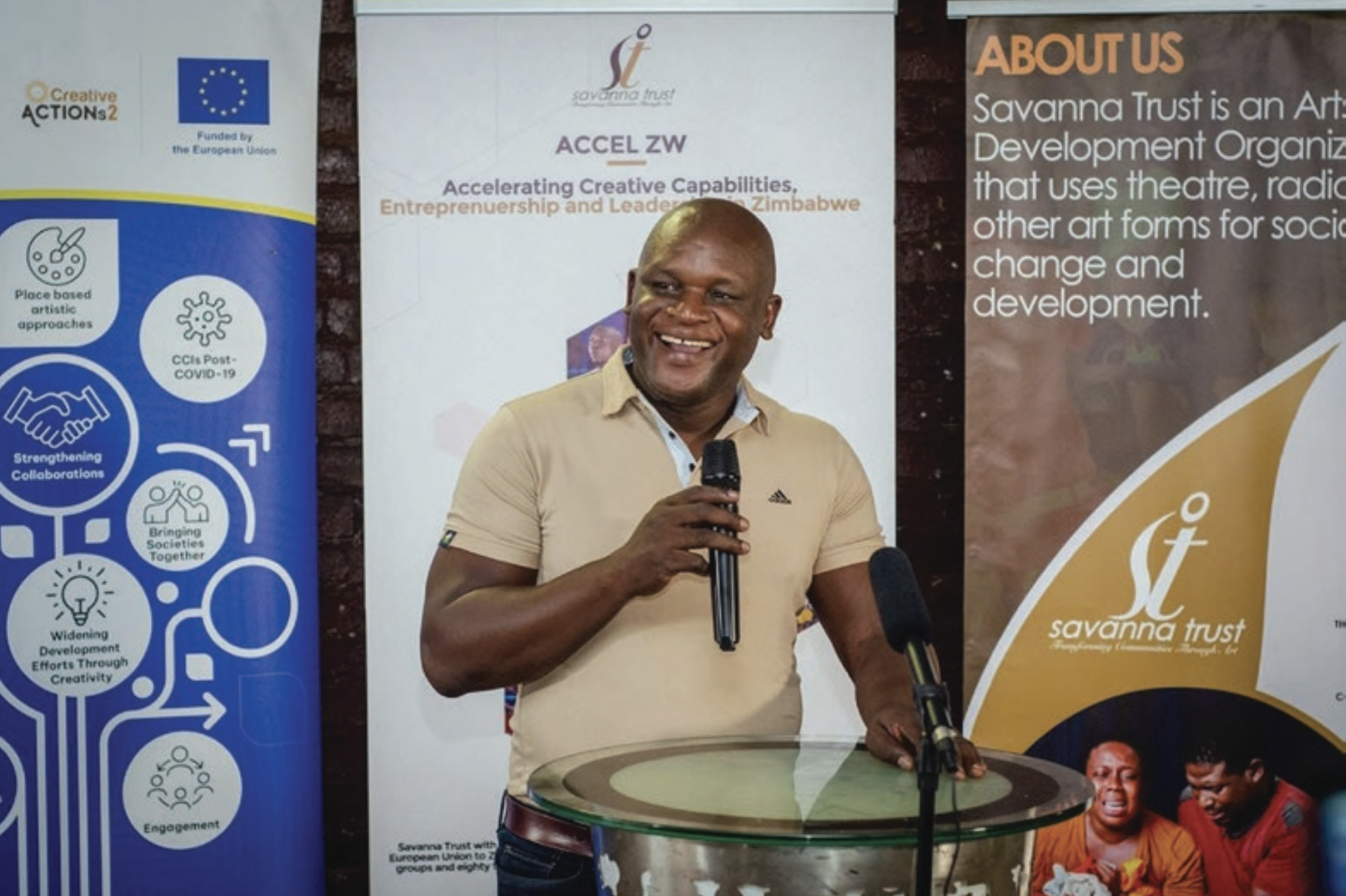
Daniel Maposa, Director of Savanna Trust at the Accelerating Creative Capabilities Entrepreneurship and Leadership Zimbabwe (ACCEL ZW) theatre Festival, in Harare, Jasen Mphepo Little theatre, 4 April 2024. (Photo by Sebastian Muzanenhamo)
FRIEDMAN: Yes, that history needs a lot more research. It needs to become a part of our global knowledge of theatre and performance. And it brings me to the pungwe because it grew out of that traditional way of performing. Can you tell us about the pungwe, and what role it played in the liberation struggle?
MAPOSA: From 1965 to 1980 [when the nation’s first elections with universal suffrage were held and an independent Zimbabwe based on majority rule was established] freedom fighters in Mozambique, in Zambia, in Botswana, in Tanzania, and in some liberated zones of Zimbabwe started performing theatre clandestinely at night as a means of boosting morale and as an educational tool to mobilize the masses to support the struggle. This all-night theatre was called a pungwe.
During the colonial period theatre institutions as we now know them, such as the National Theatre Organization—which was the only one in existence during the colonial period—grouped together whites-only theatre clubs operating from playhouses that were built by the Beit Trust, a non- pro t charitable organization founded in 1906 by white railroad tycoon Alfred Beit. ^1 We have one in Harare, the Repertory Theatre Playhouse. We have one in Bulawayo, the Bulawayo Theatre. In every major city in Zimbabwe and in mining towns as well, there were theatres that were built by the colonial regime. These were to entertain the white community who wanted to have a link between what was then Rhodesia and Britain. So, they would do a lot of Shakespeare, a lot of other Eurocentric plays. These theatre clubs focused on policies that encouraged European cultural life and perpetuated colonial culture and hegemony. Traditional theatre was discouraged or was banned, including the pungwe. Local performing arts were seen as a threat to colonial authority. The colonial powers were concerned because the performing arts, and traditional culture in general, greatly influenced the struggle for independence. Much of the suppression of indigenous theatre in colonial times came through unofficial pressure. With the settler state of Rhodesia came the Censorship and Entertainment Act of 1967, which gave the government the authority to legally ban performances.
However, the pungwe didn’t start with the liberation struggle. Let me further define what a pungwe is. “Pungwe” is a Shona word that means an all-night gathering. A pungwe is when groups of people come together for a certain purpose. It might be a religious purpose, or for a funeral, or for political/social purposes. The bottom line is that people gather all night for a common purpose. This used to happen in the precolonial period, during colonial times, and it continues in the postindependence era. It’s a cultural practice that happens within most communities in Zimbabwe.
So during the liberation struggle, the fighters used the pungwe in the War of Liberation as a way of mobilizing and teaching the masses about oppression, about the need to liberate Zimbabwe from the [Ian] Smith regime. ^2 The pungwe included dance and songs, which during the liberation struggle were called Nziyo dzeChimurenga or Songs of Liberation. Pungwe theatre during the liberation struggle was a very participatory process. People were mobilizing each other, acting together for a common purpose. So, the freedom fighters brought this already existing cultural practice and used it to mobilize and engage the masses for the common purpose of freeing themselves.
One of the things that I think most subsequent Zimbabwean theatre borrowed from the pungwe is the involvement of the so-called audiences—we call them audiences now—in the co-creation of the performance and its message. While the freedom fighters were the main actors, the masses actively participated in the process. They co-owned the performance space. They also co-owned the political space. They actively participated in organizing the event. So the success of the political messaging and the message itself was in the active mobilization of the citizens. The reason this cultural practice—which was performed by the freedom fighters with the masses—was so relevant to the people was because they could see themselves participating in a cultural practice with deep roots in their community and at the same time they were learning more about the need for liberating themselves from the Smith regime.
Some scholars like Stephen Chifunyise (1990), Kennedy Chinyowa (2012), Vimbai M. Matiza (2015), and Samuel Ravengai (2018) argue that the pungwe was an important part of the War of Liberation because it managed to bring together the freedom fighters and the masses to pursue a common goal, that of emancipation. The use of the pungwe methodology enabled the citizens to buy into the subject of liberation. The people called the freedom fighters vana, “the children.” They were the community’s children. They understood our culture, they shared our culture, our outlooks, and our practices. In contrast, the Smith regime did not want anything to do with black theatre or with black performance. They banned most of those performances, which is why they took place clandestinely. So, it was easy to get the masses to be on the side of the liberation fighters.
FRIEDMAN: What happened to the pungwe after liberation? What theatre emerged when Zimbabwe was established?
MAPOSA: After 1980 when Zimbabwe gained its independence, there was the emergence of dual forms of theatre. The National Theatre Organization that I spoke about earlier perpetuated the Western type of performance. At the same time, through government support, the Zimbabwe Foundation of Education with Production was established in 1983 as a way of educating the masses around issues of socialism, around issues of health, issues of development. It had a theatre component. Ngugı wa Mirii came from Kenya to Zimbabwe to help lead this work. There were then two camps: the Eurocentric form of theatre that was managed by the National Theatre Organization and the new form of theatre, which we can call community theatre, which soon organized itself into the Zimbabwe Association of Community Theatre (ZACT). ^3
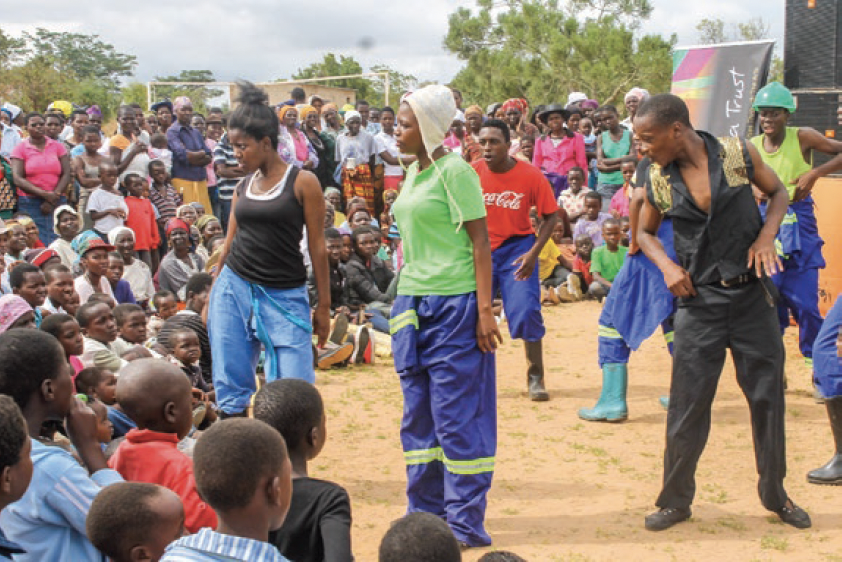
Community actors, trained by Savanna Trust, performing in a play they devised in Goromonzi, East Mashonaland, Zimbabwe, September 2012. (Photo by Leonard Matsa)
After 1980, we begin to see a number of theatre clubs emerging in Zimbabwe. That includes the Amakhosi Theatre, which I will talk about later, and Zambuko/Izibuko, ^4 which was formed at the University of Zimbabwe in 1985 by students from the English Department. The work of Zambuko/Izibuko was led by Dr. Robert McLaren and Stephen Chifunyise, two of our pioneering playwrights, who also facilitated the establishment of the Theatre Arts Department at the University of Zimbabwe. They took the leftist side; they were inspired by socialism. Their work was a perpetuation of what had been happening and the ethos that was preached during the War of Liberation. Once Zambuko/Izibuko was formed, they produced plays that denounced apartheid [in South Africa]. They were very political in that way.
In 1987 they produced Samora Continua. The play was in commemoration of Samora Machel, the first president of Mozambique. In 1986, Machel died in a plane crash believed to have been engineered by South Africa and Malawi. Samora Continua looked at Samora’s life as a Pan-Africanist who had given so much to the Zimbabwean independence struggle and was doing the same for South Africa. The performance was agitprop theatre. It aimed at raising consciousness about the struggles of Southern African people against imperialism and colonialism, about the need to complete the fight in South Africa.
Another impactful play that Zambuko/Izibuko produced was Mandela: The Spirit of No Surrender in 1989 and 1990. It also was agitprop. Basically, it dramatized Nelson Mandela’s life from the Rivonia Trial in 1963 when he and other leaders of the newly formed African National Congress (ANC) were sentenced to life in prison; the tribulations he went through while in prison; and what his wife went through when the regime wanted them to give up the struggle. The play also justified and chronicled the formation of Umkhonto we Sizwe (Spear of the Nation), the armed wing of the ANC.
Because we had just become independent, plays dealing with issues around the new government were not happening. Most of this work just after independence was in line with government policy, and in support of the liberation of the African countries still under white control, particularly neighboring South Africa and Namibia.
After 1994 when apartheid was overthrown in South Africa, there was a shift. I don’t know if
it was a coincidence, but Zambuko/Izibuko began to fizzle out. The founding students left the university. Some of the performers formed new groups. The group’s founders, McLaren and Chifunyise, started the Children’s Performing Arts Workshop, performing only children’s plays. However, before disbanding, Zambuko/Izibuko trained a lot of those who became leading performing and literary artists in Zimbabwe—people such as Albert Nyathi, Nicholas Mkaronda, Chirikure Chirikure, to mention just a few.^5 This was a very vibrant group, which started at the University of Zimbabwe and went into the communities.
FRIEDMAN: Another very important development in Zimbabwean theatre around the same time was by Cont Mhlanga [1958–2022], who was not a university student but a factory worker. In fact, as I understand it, he wasn’t even interested in theatre at first. He was a member of a karate club in Bulawayo, Zimbabwe’s second largest city and its industrial hub. One evening, members of the club arrived at the hall where they usually practiced to find that it had been rented for a theatre workshop. Cont Mhlanga stayed to observe the workshop. Fascinated, he went on to become a major influence on Zimbabwean theatre in general and political theatre in particular.^6 Could you talk about Cont Mhlanga?
MAPOSA: Cont Mhlanga, may he rest in peace, is one of the founding fathers of Zimbabwean political theatre. I think most of us today were inspired by Cont Mhlanga. Early in 1983 Mugabe’s government launched the Gukurahundi mass killings. People in the south of Zimbabwe, where Cont Mhlanga came from, mostly Ndebele people, were massacred. The government claimed that the Ndebele were hiding dissidents.^7 Cont became a very politically conscious young man at that time, very critical of the government. Then in 1980 came pronouncements of reconciliation [between black and white, between ethnic groups, and between the Zimbabwe African National Union and the Zimbabwe African People’s Union, the two parties leading the liberation struggle]. But what was said in public and what was happening in practice were two different things.
Cont started producing plays very critical of the government and of Zimbabwean society in general, critical of the relationship between whites and blacks, but also of black people themselves, between the Ndebele and the Shona and the other ethnic groups. Plays criticizing Robert Mugabe were unheard of between 1980 and 1990. But Cont Mhlanga took the bull by its horns.
One of his first plays, which made him very popular all over Zimbabwe, was Workshop Negative [1986], a play that criticized the government, society, and relations between the Zimbabwe’s different racial and ethnic groups. Workshop Negative depicts two former enemies in Zimbabwe’s War of Liberation—one black, the other white—who work together. They are exploited by their black employer who claims to be a communist but is all too obviously a capitalist. The parallel to Mugabe and the situation in Zimbabwe, whose government claimed to be anti-imperialist and socialist, but where virtually all the means of production remained in private hands and where the gap between rich and poor widened, were not subtle.^8 The government was not happy with Workshop Negative. After a very popular tour of Zimbabwe, the production was scheduled to visit Botswana and other southern African countries, but the government denied clearance.^9
Cont’s next play to make a splash was Dabulap [1989], a play about young Zimbabweans crossing the border into South Africa to look for opportunities. These days we talk about illegal migrants all over the world. Cont Mhlanga foresaw what was coming.
Sinjalo [We’re Like That; 2002] used humor to show working class life in Zimbabwe, including the ongoing tensions between the Shona and Ndebele. Like all Cont’s plays, it mixed Western with indigenous theatre, including direct address to the audience. It was later adapted to television and became one of Zimbabwe’s most beloved sitcoms, running for 16 seasons.
The Good President [2007] was Cont’s most controversial play. He wrote it during the “Save Zimbabwe” campaign, which was attempting to open up the political system and provoked brutal physical attacks on many opposition leaders. Cont saw early on what was happening in Zimbabwe: the misrule by the Mugabe regime. The Good President satirically surveys Zimbabwean history since independence. It goes back to the Gukurahundi massacre of 1983. It exposed the corruption of the government over the years and blamed Mugabe’s misrule for the economic meltdown that Zimbabwe was going through at the time. He premiered the play in an open-air production in a park in Harare. It attracted large crowds, and after each performance, Cont would discuss it with the audience. However, when he took it back to his theatre, the Amakhosi Theatre, in his hometown of Bulawayo, the police stormed the auditorium after the first scene, shut down the theatre, arrested Cont, and banned the play. He was released a few days later. He was arrested and jailed for short periods throughout his career.^10
FRIEDMAN: The theatre he founded, Amakhosi, which means “Traditional Leaders” in Ndebele, still survives and has inspired many other theatres.
MAPOSA: Yes, Cont Mhlanga was the first theatre person to build an independent cultural center in Zimbabwe. He opened the Amakhosi Cultural Center in Makokoba Township in Bulawayo in 1995. The land was donated by the Bulawayo city council, which gave him the resources to nance the building that is still there now. Amakhosi still thrives. In fact, they will be performing in Harare tomorrow. When Cont transitioned into radio and television he trained younger people to run Amakhosi. He co-owned a radio station in Bulawayo. In 2021 Cont got one of the six television licenses the government awarded in the country.
FRIEDMAN: Let’s shift to the Savanna Trust, which you founded and have led for decades. Savanna is one of the most active and influential political theatres in Zimbabwe today. Because you and the Savanna are intertwined let’s start with you. How did you rst become interested in theatre?
MAPOSA: By accident. I never did theatre in school. I never thought about becoming a theatre practitioner. I was interested in music. In 1992 after I left school I was looking for a job. I visited the Zimbabwe College of Music. And guess what? There were auditions for a play going on. I didn’t even know what acting was but I got a part in Money Land [1992]. I fell in love with performing because of the way that it opened up possibilities. I used to be a very shy guy. But every time I went onstage, I felt liberated. I could be anybody.
My introduction to theatre was through that play, which was about how bad the economic structural adjustment programs introduced in 1992 by the International Monetary Fund [IMF] and the World Bank were. My generation was the first to be affected by those programs. There were massive retrenchments. Jobs were scarce. But I was not very politically conscious at age 20. So I found myself doing theatre. I linked up with Charles Mungoshi, an alum of Zambuko/Izibuko. He cast me in the lead of his Dog Eat Dog [1995]. As with many of our plays it has yet to be published.^11
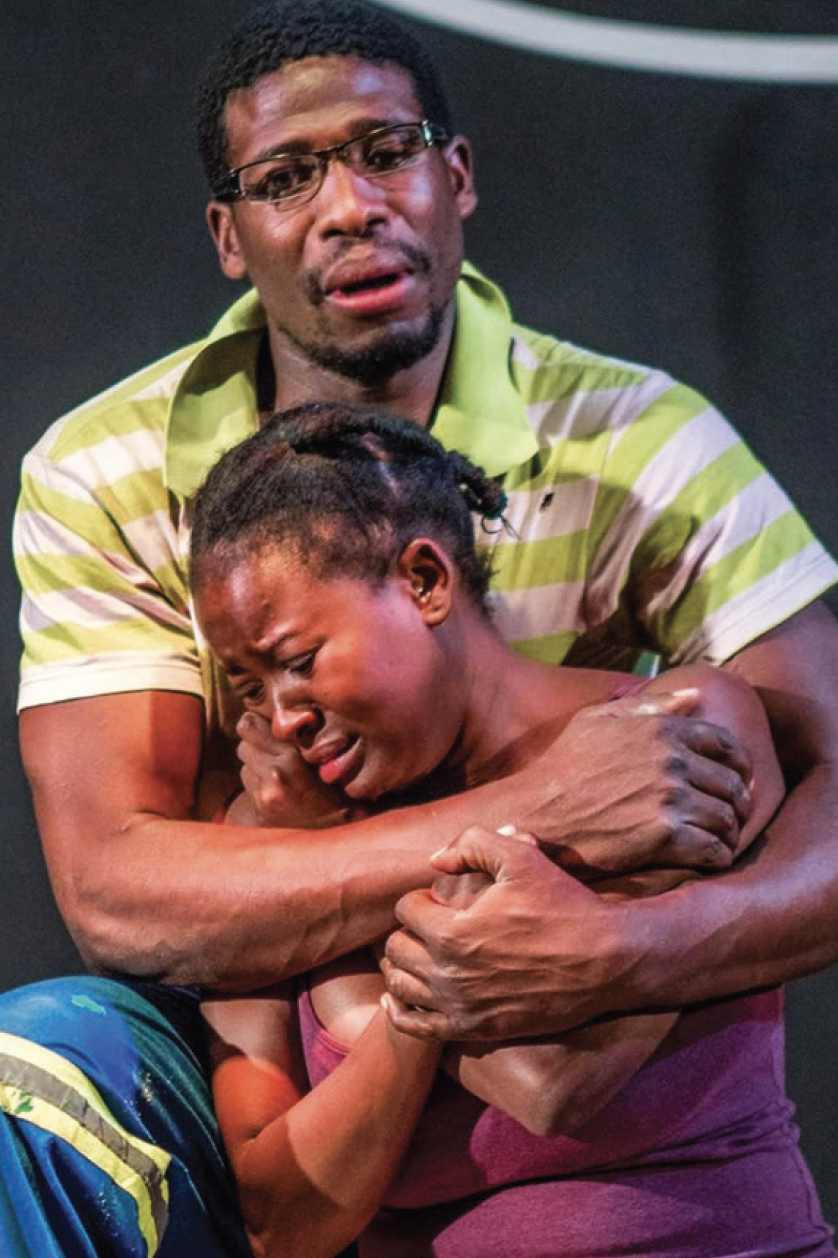
Teddy Mangawa and Charlene Mangweni-Furusa in Ukama (2024) by Bongani Benedict Masango at the Rostrum eatre, Tshwane University of Technology, Pretoria, South Africa. “Ukama” is a Shona word that implies a close relationship and interdependence between humans and among all things in nature. (Photo by Tafadzwa Furusa-Motion Zebra)
FRIEDMAN: Tell me about Dog Eat Dog.
MAPOSA: It’s about Comrade Ropamudombo [a nom de guerre that means “Blood and Stone” in Shona], a disabled freedom fighter, a veteran of the War of Liberation. He returns from the war to live a pauper’s life in a shack with his small family while his corrupt comrades, who did not even hold a gun, enjoy looting the country.
Ropamudombo’s first daughter disappears after claiming that she was impregnated by a high-ranking government official who is also Ropamudombo’s wartime friend. The same friend cons him out of his war veterans’ compensation funds. In despair, Comrade Ropamudombo commits suicide. The story is about how the real freedom fighters were neglected in independent Zimbabwe, how those who did not go to the front lines were enjoying the country’s resources through corruption and oppression of citizens. It was performed in different theatre spaces in Harare and in the park. We toured townships and played a few venues outside of Harare. Through Dog Eat Dog my political consciousness developed. I found out that I loved plays that talked about the day-to-day issues that were affecting especially young people in Zimbabwe. At first, I was an actor. Then I acquired different skills, not by going to college but through performing. I learned how to write. I learned how to direct. I also learned how to produce.
Titus Moetsabi, who directed Money Land and went on to a career as a Communications for Development Specialist with UNICEF [United Nations International Children’s Emergency Fund]; the playwright Nicholas Mkaronda, myself, and few others founded Savanna Arts in 2006. We created performances that helped NGOs communicate within their organization and outside. We did educational theatre, performing in schools, stuff like that. When we performed for the Student Christian Movement, they offered us a small office free of charge. We learned about politics, rights, democracy, and justice by creating short plays for these NGOs.^12 That is how my theatre history began.
FRIEDMAN: When did Savanna begin producing full-length plays?
MAPOSA: Siphofami [2002] was our maiden full-length play. This was when Mugabe was saying homosexuals are worse than pigs and dogs. So, we devised a play that was responding to that and performed in various cities across the country.^13 The central theme of Siphofami was: what would you do if your daughter told you that she’s a lesbian? We wanted to generate public dialog, to say, “This is an issue in our society, so how do we begin to talk about it?”
Nicholas Mkaronda was then the artistic director and I was the administrator of Savanna. At the same time as Siphofami, Nicholas started doing research documenting political violence in the country. The intelligence service came after him. He had to skip the country. He went to Botswana and then to South Africa. I was alone. Things got hard. I had to push to keep Savanna going. I had to look for jobs to pay my personal rent.
I worked for the Zimbabwe Broadcasting Corporation for about six or eight months. Then I joined Rooftop Promotions, a theatre promotion company led by Daves Guzha, a prominent Zimbabwean artist with a long history producing both theatre and lm. He is also an activist. Rooftop plays are usually showcased at Theatre in the Park in Harare where the group is in residence.^14
In 2006, I transformed Savanna from a club into a trust. A theatre club in Zimbabwe is informal. A trust in Zimbabwe is a legally registered nonproit organization. We registered Savanna Trust with me as the founding director, then recruited relatively young people who were not experienced. We said, “Let’s start from zero and build an institute. We don’t want to be just a theatre group, we want to professionalize the arts.” That’s the vision that I had. You know, theatre in Zimbabwe most people treat as a part-time activity. There are mostly informal theatres that meet as they will and when they can find space. But we said, “Let’s have an organization that is professionally run and that implements good governance so that we become the example, not only in the theatre, but also for the causes that we’re fighting for.”
This transformation coincided with a period of intense government repression known as Operation Murambatsvina [Move the Rubbish], which included the forceable eviction of 700,000 poor people from urban slums, blocking humanitarian aid from abroad, and further restricting civil liberties.15 This period was 2005–2009. Before then, Savanna’s work had been very broad. At that point, we decided to focus on human rights, on how the regime was oppressing Zimbabwean citizens. We began producing hard-hitting political theatre.
The government came down on Savanna—and the theatre in general—with a heavy hand.
They realized that we were becoming a critical voice in society. They began to harass performers, directors, producers. There were no longer spaces in communities made available for us to perform in. So, in 2007, we came up with the strategy of hit-and-run theatre. We would go to a township or a shopping center or an outdoor market and perform a 10- to 15-minute production making people aware of the issues that were affecting their community, encouraging people to vote, encouraging people to participate in the political processes in their communities. And then, before the police knew about it, we were gone. It was guerrilla theatre. We didn’t advertise. We would just show up, do our short play and then leave. Those were the formative years of Savanna Trust.
FRIEDMAN: That’s the period when I met you. I was very impressed with how you would gather a crowd with song and dance, and then, once the crowd was there, put on a play that had something to say. Then you’d disappear.
MAPOSA: That kind of play was more agitprop. We had two ways of performing. We did hit-and-run theatre mostly in politically polarized communities. We also did some full-length indoor shows. We didn’t get into as much trouble with them because the venues where we performed were small theatres and the government thought that our audiences were so small that it would not change very many mindsets.
FRIEDMAN: Is that the period when you organized the Protest Arts Festival that brought theatre groups from all over Zimbabwe, and beyond, to Harare?
MAPOSA: In 2009 we started the Protest Arts International Festival, which lasted until 2011. The festival included theatres from Zimbabwe, Botswana, Kenya, Malawi, and South Africa [Chitanana 2010]. It raised the visibility of protest theatre and contributed to the democratization of Zimbabwe and other African countries.
FRIEDMAN: Did the government try to shut down the festival?
MAPOSA: No, but during the second festival, in 2010, some people tried to abduct me after I gave my director’s remarks. I assume they were government agents, though I don’t know for sure. They held me by the belt and pulled me outside. Fortunately, other people came out and the guys ran away. To go home, we swapped cars. One friend drove me and another friend took my car. They followed my car for some kilometers until they realized the direction the car was going was not where I lived. Later that night my friend dropped me off safely at home. By the third festival, the government left it alone because it had grown so large that if they had shut it down, a lot of people would have noticed.
While we were doing hit-and-run theatre, we also dealt a lot with, and still deal a lot with, educating communities on their rights, trying to mobilize them to participate in political processes and government processes. This part of our work was more focused on rural and poor urban communities, encouraging citizens to be critical about governance issues, trying to mobilize young people to be active participants in governance processes on the micro level in their communities. This is the other avenue that we use our plays for.
FRIEDMAN: That leads directly to the work you’re doing today. Can you tell us a little bit about the interactive theatre that you’re bringing to villages around the country?
MAPOSA: We asked ourselves: “Why do we have oppression and violence in our communities?” It could be gender-based violence, it could be political violence, it could be child abuse. Why do we have such violence? We realized there are two participants in the oppression. The first is the oppressor, the violator. Sometimes the violators are more than high officials or high-ranking military. Many military are youths who are being used by the powerful people. So, we said, “Those young oppressors must also be liberated.” They don’t just wake up and say, “I want to be an oppressor” or “I want to violate someone’s rights.” It is the whole system, the acculturation, the whole set of values that they learn from the elders, that they learn from the political parties and the like. So, we said, “They also must be active participants in terms of freeing themselves.” It is something close to [the work of Augusto] Boal, but very, very different. We don’t emphasize the difference between oppressor and oppressed. In the same process while liberating the oppressed we want to liberate the oppressor as well. We need to empower all the citizens. Often, they as a community are passive, they look side- ways while such violations happen. We realized there is a need for dialog between these two forces. So, we departed from our confrontational theatre to create a hybrid process that would allow people to think and reflect and, at the same time, at the center of it, to dialog in a peaceable manner.
What we do is we go into the community. We go through community groups, through traditional leaders, through councilors, and also make sure that we are known to those who are called the “district development coordinators,” who are in charge of the district for the government. So, the community people do the mobilization for us.
When we come to a community, we focus on process. One of the processes is that we train local community theatre artists in the villages. We find that there are always people who have an interest in theatre, but they never have had the opportunity to do it. Some are poets, some are school drop- outs. We stimulate them to form their own theatre clubs. We identify local community artists— singers, dancers, poets—who we then enable with acting skills. We enhance their skills if they were already performing. We also borrow from community performance. You know in Africa, we use a lot of music, a lot of dance. That’s how you sustain people’s interest. We use their local dances, their local songs to sustain interest and also to communicate.
Then they devise and produce the plays. They initiate dialog around the things that people think are pertinent and begin to create a play around those issues and concerns. Then they test it in their community. Once the play is ready, they mobilize the community to come to the local community center. They perform for their entire village or township. We don’t import actors from outside. We empower local actors to identify their issues. When they identify their issues, they then create and produce a play that speaks to their concerns. Then mobilization becomes very easy.
In a way, it is a borrowing from the pungwe theatre of the liberation struggle where there was community involvement in the messaging and in the performances. When people see young people from their community performing—and sometimes these are young people who had nothing to do, who were roaming around townships getting into trouble and now they are performing, they have the skills—they will definitely attend the productions. So, we co-create with the community. The community owns the performance process. The community owns the messages, and the community owns the discussions that the performances provoke. After the performance they carry out discussions about the issues that come out of the play and then can break the members of the audience into focus groups where they begin to prioritize action points and discuss how they can tackle specific issues. This, in brief, is our process when dealing with communities. We have developed and sustained 15 new community-based theatre groups around Zimbabwe.^16
Also, one of the major processes that we now do in the community is to deal with local issues, say a water shortage. We bring local elected councilors from that particular village or district to see the plays and begin to engage with their community, to respond to the questions their communities are asking. That’s how we tackle community problems. That’s how we tackle issues of political violence. That’s how we encourage peace within our communities. Even issues of gender violence. We encourage community members and their leadership to interface so that they can solve their own problems.
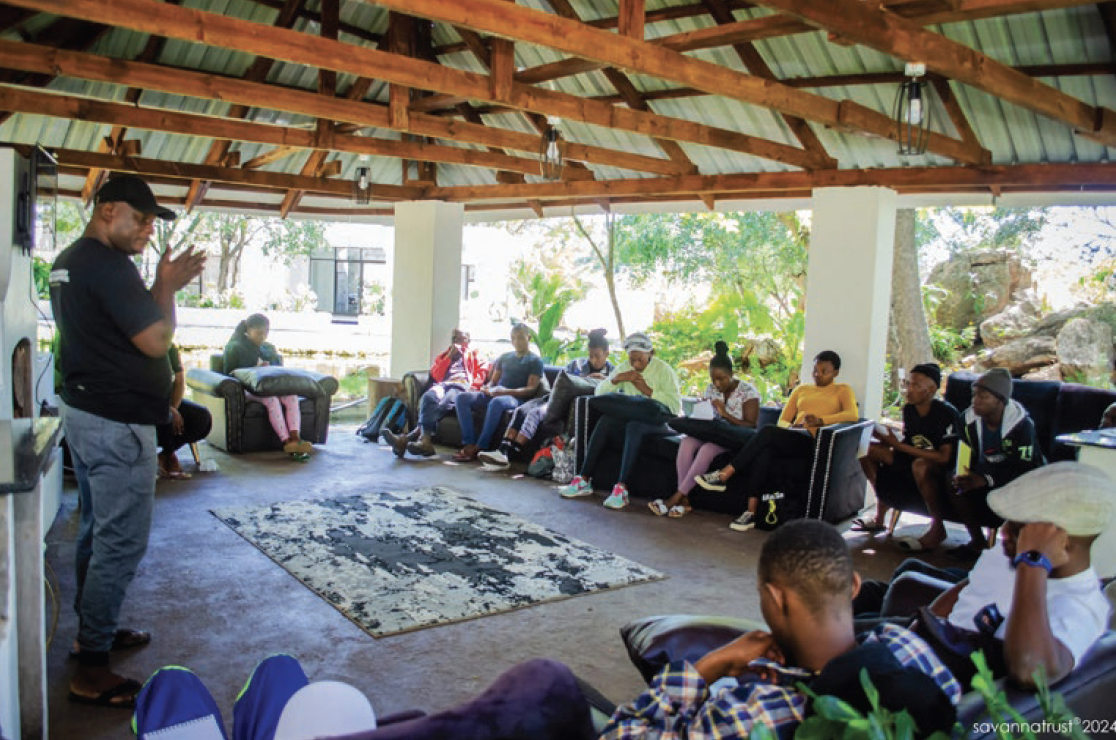
Daniel Maposa leading a theatre training in Bulawayo, Matabeleland, Zimbabwe, 11 June 2024. (Photo by Sebastian Muzanenhamo)
FRIEDMAN: One of the things I find so exciting about your work is that you’ve qualitatively moved from didactic theatre, which is the actors teaching the audience, to a collective process where the audience itself identifies, explores, comes up with questions and answers on its own—and performs them.
ZION RACZENSKI [student from University of North Carolina, Greensboro]: I was wondering how political theatre has shaped you on an emotional or personal level, what values you’ve taken away from it.
MAPOSA: In our context and from a personal point of view, my involvement in political theatre has allowed me to better appreciate and understand life, to appreciate and understand our diversity as a people, and also, from a justice point of view, to have the commitment to say, “I will not keep quiet when I see injustice being done.” Probably I will not do it in a way that most activists would do it. Probably I will do it through a performance.
Doing political theatre in a hierarchical and patriarchal society such as Zimbabwe, I have begun to appreciate issues of inclusion. All this stems from my view that we are all citizens of the world. Despite all our diversity, we are the same in that we aspire for freedom and a good life, for a society that provides us with a conducive environment to achieve our dreams. Political theatre has given me a perspective to better understand what is most important in life, in society and for the individual.
_________________________
1. The Alfred Beit Trust was founded upon Beit’s death in 1906 and was active in the former Federation of Rhodesia and Nyasaland (present-day Zimbabwe, Zambia, and Malawi). During the colonial period it built many “Beit Halls”—cultural centers in schools, colleges, and other locations where lm screenings, plays, and concerts took place. The Beit Trust still exists; in postindependence Zimbabwe the trust is primarily involved in providing grants to schools, hospitals, and community health centers, and postgraduate scholarships for Zimbabwean students to study in British and South African universities.
2. Ian Douglas Smith was the first and only prime minister of Rhodesia (1964–1979), the name given to the white supremist settler state that ruled what is now Zimbabwe during that period. In response to Britain’s demand that independence of the colony be accompanied by majority rule, Smith declared in a televised speech on 20 March 1976, “I don’t believe in majority rule in Rhodesia—not in 1,000 years” (Rees 1984:247). Under the Rhodesian state all prime farmland was owned by whites; voting was restricted by education, property ownership, and income, effectively disen- franchising blacks; all leading positions in the public services were reserved for whites; and whites working in manual occupations enjoyed legal protection against job competition from black Africans. Smith led an unsuccessful 15-year war against black liberation forces, called the “Bush War” by the government and the “War of Liberation” by the Black majority, which ended in the establishment of Zimbabwe in 1980.
3. The Zimbabwe Association of Community theatre (ZACT) was founded in 1986 as part of the Zimbabwe Foundation for Education with Production (Zimfep). It was funded by the government and was designed to support existing community theatre groups and to encourage the development of new ones. ere is no exact record of the number of theatre groups that belonged to it, but at its height, it was undoubtedly the largest association of community theatre groups in Zimbabwe. Initially, it encouraged reliance on indigenous performance traditions and the engagement of day-to-day social issues. In 1990, when the government abandoned its public commitment to a socialist economy and instead became reliant on a World Bank and International Monetary Fund sponsored economic restructuring program, government funding of ZACT was reduced to a trickle. It became reliant on funding from Europe, primarily Scandinavian nongovernment agencies. Subsequently, its focus on indigenous forms and its agitational function waned. Although it still exists, in the 1990s many of its member theatre groups transformed into NGOs, arts trusts, or switched to producing commissioned applied theatre projects. For more see: Sibanda (2019) and Seda (2011).
4. The name Zambuko/Izibuko consists of two words, one from each of Zimbabwe’s two major languages, Shona and Ndebele; both mean to “ford or cross a river.” According to Robert Mshengu McLaren, they saw themselves and Zimbabwe posed to “march across the river from colonialism, racism, sexism and capitalism to independence and equality to socialism” (1992:90–114).
5. Albert Nyathi is a poet, musician, writer, actor, and philanthropist. Nyathi is particularly famous for the poem and song “Senzeni na?” (What Have We Done?), which he composed following the assassination of Chris Hani, the leader of the South African Communist Party in 1992. As a poet, he has toured Botswana, Denmark, the Netherlands, Rus- sia, South Africa, the United States, and Zambia. Nicholas Mkaronda is a playwright and director who was a Lecturer in the theatre Arts Department of the University of Zimbabwe in the 1990s. He went on to become an Anglican priest and served as the principal of the Newton Theological College in Papua New Guinea. Chirikure Chirikure is a poet, songwriter, translator, and author of children’s stories, and has published several educational textbooks. He is a graduate of the University of Zimbabwe and an Honorary Fellow of the University of Iowa. Chirikure worked with College Press, one of Zimbabwe’s leading publishing houses, as an editor/publisher for 17 years. He now runs a literary agency and also works as a performance poet, cultural consultant, and translator. He performs his poetry solo and/or with his mbira music ensemble.
6. “I didn’t know what a drama club was,” Mhlanga recalled in 1987, “but I had nothing else to do so I paid 20 cents and went in” (in Bartlett 1987).
7. Gukurahundi is a Shona word that translates as “the early rain which washes away the cha before the spring rains.” In Zimbabwean history it refers to the mass killings in 1983–84 conducted by the Fifth Brigade of the Zimbabwe National Army. Thousands of Mathebele were detained and either marched to re-education camps, tortured, raped, and/or summarily executed. Although there are different estimates, the consensus of the International Association of Genocide Scholars (IAGS) is that more than 20,000 people were killed (IAGS 2005).
8. Mhlanga said the play was meant to show “what ordinary factory workers like me are thinking.” In response to government repression of the play on the grounds that it attacked socialism, he asked, “How can I be attacking socialism when the play attacks the abuse of socialism?” (in Bartlett 1987).
9. “Workshop Negative [1986], Amakhosi’s [name of Cont’s theatre group] phenomenally successful analysis of racial reconciliation in an industrial setting, which was also an allegory of the betrayed promises of Zimbabwean independence, became a cause célèbre, initiating a national debate” (Kerr and Chifunyise 2004:300).
10. “I will not rewrite the play. How can a play based on true historical events and incidents and on knowledge in the public domain be unlawful? I did not base my creativity on fictitious events and incidents [...] If I am going to change anything in my script, it will be punctuation marks. I am not changing anything else” (Mhlanga in Kwidini 2007; see also Smith 2009; and The Zimbabwean 2007).
11. Other Savanna plays yet to be published include: Heaven’s Diary (2002); Decades of Terror (2009); Fes’bhuku (Face- book) (2011); Half Empty/Half Full (2013); Liberation (2016); Ukama (Relationship) (2017); and Deathbed (2021).
12. Some of the NGOs that Savanna Trust worked for, and the issues it addressed with them include: the Zimbabwe Coalition on Debt and Development; the Musasa Project and Zimbabwe Women Lawyers Association, on gender-based violence; United Nations Development Programme, on the constitution making process; Crisis in Zimbabwe Coalition, on democracy and elections; the Zimbabwe Institute on the Private Voluntary Bill, on women’s participation in electoral processes; and Childline Zimbabwe and Roots, on child protection.
13. Siphofami was performed throughout Zimbabwe in theatre venues, community halls, and schools: in Harare at theatre in the Park and the Reps Theatre, as well as schools; in Bulawayo at the Amakhosi Theatre; in Masvingo at the Charles Austin theatre and in various schools; in Mutare at the Courtauld Theatre; and in Kadoma at the Campbell theatre.
14. For more on Rooftop Promotions see Matiza (2022).
15. For more on Operation Murambatsvina see Bratton and Masunungure (2007) and Howard-Hassman (2010).
16. Among the troupes generated around the country are: Shangano Arts, based in a small mining town called Hwange; Intembawzyo theatre group based in Binga; Berina Arts Ensemble based in Kadoma; Baptism of Fire based in Karoi; and Jahunda Community Arts based in Gwanda.
References
Bartlett, Lawrence. 1987. “Play about Political Corruption Causes Stir in Zimbabwe.” AP News, 1 July. Accessed 8 August 2023. apnews.com/77c8cf92575bccedfa9cf1fff7a10221
Bratton, Michael, and Masunungure, Eldred. 2007. “Popular Reactions to State Repression: Operation Murambatsvina in Zimbabwe.” African Affairs 106, 422:21–45. www.jstor.org/stable/4496414
Chifunyise, Stephen. 1990. “Trends in Zimbabwean Theatre Since 1980.” Journal of Southern African Studies 16, 2:276–89. www.jstor.org/stable/2637078
Chinyowa, Kennedy C. 2012. “Building Critical Citizenship Through Syncretic Theatre: A Zimbabwean Case Study.” Journal of Peacebuilding and Development 7, 2:67–78. doi.org/10.1080/15423166.2012.743816
Chitanana, Tenford. 2010. “Zimbabwe Protest Arts International Fes Goes Beyond the Line.” Shout Africa, 19 November. Accessed 24 April 2024. https://www.shout-africa.com/?s=Tenford+Chitanana
Howard-Hassman, Rhoda E. 2010. “Mugabe’s Zimbabwe, 2000–2009: Massive Human Rights Violations and the Failure to Protect.” Human Rights Quarterly 32, 4:898–920. www.jstor.org/stable/40930339
International Association of Genocide Scholars (IAGS). 2005. “Resolution on State Repression in Zimbabwe.” International Association of Genocide Scholars. https://genocidescholars.org/wp-content/uploads/2019/04/ IAGS-RESOLUTION-ON-ZIMBABWE-7-June-2005.pdf
Kerr, David, and Stephen Chifunyise. 2004. “Southern Africa.” In A History of Theatre in Africa, ed. Martin Banham, 265–311. Cambridge University Press.
Kwidini, Tonderai. 2007. “Mugabe’s Fist Comes Down on Stage.” Mail & Guardian, 17 July. mg.co.za/ article/2007-07-17-mugabes- st-comes-down-on-stage/
Matiza, Vimbai Moreblessing. 2015. “Pungwe Gatherings as Forms of Drama for Development Through Music in Zimbabwe.” Muziki: Journal of Music Research in Africa 12, 1:63–73. doi.org/10.1080/18125980.2015.1031450
Matiza, Vimbai M. 2022. “Protest Theatre and Zimbabwean Politics: The Case of Rooftop Promotion Productions.” London Journal of Research in Humanities and Social Sciences 22, 6:53–61.
Mshengu McLaren, Robert. 1992. “Theatre on the Frontline: The Political Theatre of Zambuko/Izibuko.” TDR 36, 1 (T133):90–114. doi.org/10.2307/1146181
Ravengai, Samuel. 2018. “Decolonising Theatre: Subverting the Western Dramaturgical Frame in Zimbabwean Theatre and Performance.” Critical Arts 32, 2:15–30. doi.org/10.1080/02560046.2018.1452952
Rees, Nigel. 1984. Sayings of the Century. Allen and Unwin.
Seda, Owen. 2011. “Interculturalism in Post-Colonial Zimbabwean Drama: Projections of an Alternative
Theatre at the Onset of the New Millennium.” PhD diss., University of Zimbabwe.
Sibanda, Nkululeko. 2019. “Conceptualizing Alternative Theater and Alternative Performance Space in
Postindependence Zimbabwe.” SAGE Open, 1–11. doi.org/10.1177/2158244019846699
Smith, David. 2009. “Letter from Africa: ‘When You Tell a Joke in the Street, That Is Political.’” The Guardian,
12 May. www.theguardian.com/world/2009/may/12/david-smith-cont-mhlanga
The Zimbabwean. 2007. “The Good President.” The Zimbabwean, 21 June. www.thezimbabwean.co/2007/06/ the-good-president-21-06-07/#google_vignette
TDReadings
Friedman, Dan. 2016. “Theatre, Community, and Development: The Performance Activism of the Castillo Theatre.” TDR 60, 4 (T232):68–91. doi.org/10.1162/DRAM_a_00596
Johansson, Ola. 2010. “The Limits of Community-Based Theatre: Performance and HIV Prevention in Tanzania.” TDR 54, 1 (T205):59–75. doi.org/10.1162/dram.2010.54.1.59
Mshengu McLaren, Robert. 1992. “Theatre on the Frontline: The Political Theatre of Zambuko/Izibuko.” TDR 36, 1 (T133):90–114. doi.org/10.2307/1146181